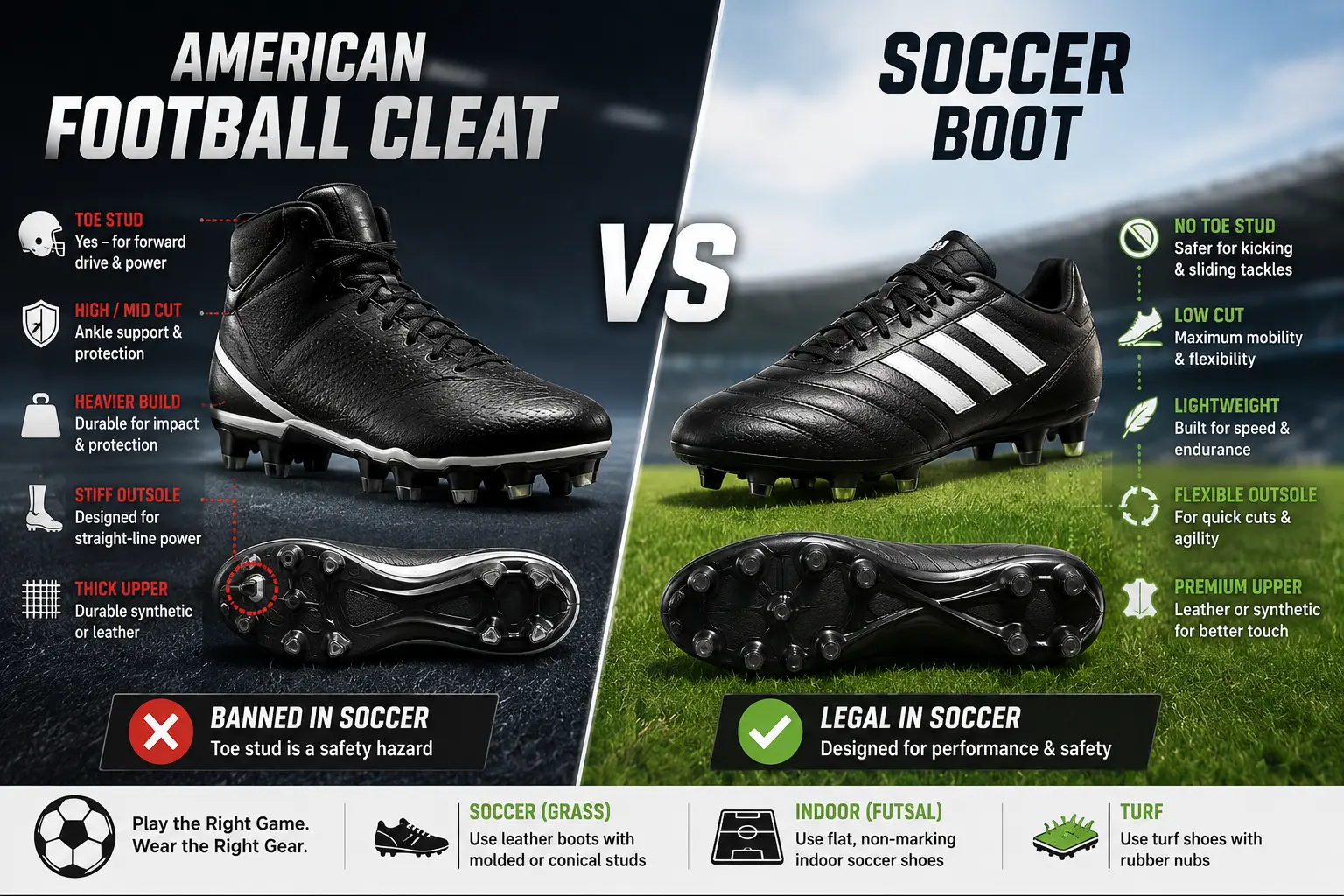
If you’re a multi-sport athlete or a parent looking to save money on sports gear, you’ve probably wondered: Can you wear football cleats in soccer? Since both types of shoes have studs for traction, they may seem interchangeable at first glance. However, their design, performance, and safety features are very different.
The simple answer is no. Traditional American football cleats are not permitted in official soccer matches because they don’t meet the safety standards set for the game. On the other hand, soccer cleats are often allowed in American football and are even preferred by some players in specific positions.
Choosing the wrong footwear doesn’t just affect your performance—it can also increase your risk of injury and, in competitive soccer, prevent you from playing altogether. That’s why understanding the differences between football and soccer cleats is essential before stepping onto the field.
In this guide, we’ll explain why football cleats aren’t suitable for soccer, whether soccer cleats can be used for football, and how to choose the right footwear for grass, artificial turf, and indoor courts. By the end, you’ll know exactly which cleats are best for your sport and playing surface.
Quick Answer: Can You Wear Football Cleats in Soccer?
No. Traditional American football cleats are not allowed in official soccer matches. The biggest reason is the toe stud found on football cleats, which can pose a safety risk during tackles and challenges.
While you might get away with wearing them in a casual backyard game, most leagues and tournaments require referees to inspect players’ footwear before kickoff. If your cleats have a front toe stud or don’t meet soccer regulations, you’ll be asked to change them before you’re allowed to play.
The good news is that soccer cleats can be worn in American football, especially by kickers, punters, wide receivers, and defensive backs who prioritize speed and agility over heavy protection.
Why Are Football Cleats Not Allowed in Soccer?
Although football and soccer cleats look similar, they’re built for completely different sports. American football focuses on explosive forward movement, blocking, and physical contact, while soccer requires constant running, quick changes of direction, ball control, and kicking accuracy.
The most important difference is the toe stud.
Football cleats include a stud directly beneath the toe to provide extra grip when players push forward. This design helps linemen and running backs generate power, but it’s considered dangerous in soccer because players frequently tackle, slide, and challenge for the ball. A front toe stud can catch an opponent or cause serious injuries during contact.
In addition to the toe stud, football cleats are generally heavier and feature thicker ankle collars. While this provides extra support during physical collisions, it also limits the flexibility and freedom of movement that soccer players need for dribbling, passing, and shooting.
Soccer cleats, by contrast, are lightweight and designed to maximize touch, agility, and comfort while keeping players safe.
Can You Use Soccer Cleats for Football?
Unlike football cleats, soccer cleats are legal for American football and are commonly used by players who rely on speed, agility, and precise footwork. Kickers and punters, in particular, often prefer soccer cleats because their lightweight design provides a cleaner striking surface and better control when kicking the ball.
Players in positions such as wide receiver, cornerback, and defensive back may also choose soccer cleats if they prioritize speed over protection. Their low-profile design allows for quicker acceleration and sharper cuts, making them a practical option in certain situations.
However, soccer cleats are not the best choice for every football position. Linemen, linebackers, and tight ends regularly engage in heavy physical contact, where extra ankle support and foot protection are essential. Football cleats are specifically designed to handle these demands, making them the better option for players in the trenches.
Why Soccer Cleats May Not Be Ideal for Football
Before wearing soccer cleats for football, consider these limitations:
- Less Ankle Support: Most soccer cleats have a low-cut design that maximizes mobility but offers minimal ankle protection.
- Reduced Foot Protection: Soccer boots are lightweight and have thinner uppers, making them less effective against heavy impacts or players stepping on your feet.
- No Toe Stud: Without a front toe stud, players may lose some forward traction during blocking and explosive starts.
- Lower Durability for Contact: Soccer cleats are designed for continuous running and ball control, not repeated collisions and physical contact.
If you play a speed-focused position, soccer cleats can work well. But if your role involves blocking, tackling, or pushing opponents, dedicated football cleats remain the safer and more effective choice.
Football Cleats vs. Soccer Cleats: What’s the Difference?
Although they may look similar, football and soccer cleats are engineered for different sports. Here’s a quick comparison to help you understand the key differences.
| Feature | Football Cleats | Soccer Cleats |
| Toe Stud | ✅ Yes | ❌ No |
| Ankle Support | Low, Mid, or High-Cut | Mostly Low-Cut |
| Weight | Heavier | Lightweight |
| Primary Purpose | Power, Blocking & Traction | Speed, Ball Control & Agility |
| Upper Material | Thick Synthetic or Leather | Synthetic, Knit, or Leather |
| Legal in Soccer? | ❌ No | ✅ Yes |
| Legal in Football? | ✅ Yes | ✅ Yes |
The biggest distinction is the toe stud, which is mandatory on most football cleats but prohibited in soccer due to safety concerns. Soccer cleats also prioritize flexibility and close ball control, whereas football cleats focus on stability, protection, and explosive forward movement.
Why Many Players Still Prefer Leather Soccer Boots
 Modern soccer boots are dominated by lightweight synthetic materials, but leather soccer boots remain a favorite among many experienced players. While they may not be as flashy as the latest knit designs, they continue to offer unmatched comfort and natural ball feel.
One of the biggest advantages of leather is its ability to mold to the shape of your foot over time. This creates a personalized fit that improves comfort during long matches and training sessions.
Leather also provides a softer first touch on the ball, making passing, dribbling, and shooting feel more natural. In addition, quality leather boots tend to be highly durable when properly maintained, making them a worthwhile investment for players who value comfort and long-term performance.
If you’re new to soccer or simply want a boot that balances comfort, durability, and control, a premium leather soccer boot is still one of the best options available.
Playing Indoors? Choose the Right Soccer Shoes
If you’re playing on indoor courts or artificial turf, wearing the right footwear is just as important as choosing the correct cleats for outdoor games. Traditional football or soccer cleats with long studs are designed for natural grass and can become uncomfortable—or even dangerous—on harder surfaces.
For indoor soccer, there are two main types of shoes to consider.
Indoor Court Shoes (IN)
Indoor court shoes, also known as futsal shoes, feature a flat, non-marking rubber sole that provides excellent grip on polished gym floors and indoor courts. Since they don’t have studs, they allow players to move quickly without slipping or damaging the playing surface.
These shoes are ideal for:
- Futsal matches
- Indoor sports halls
- Wooden or concrete courts
Turf Shoes (TF)
Turf shoes are designed for artificial grass with a short pile. Instead of large studs, they feature dozens of small rubber nubs that distribute pressure evenly and provide consistent traction without digging into the surface.
They’re best suited for:
- Artificial turf fields
- 5-a-side soccer
- Training sessions on synthetic grass
Pro Tip: Never wear outdoor football or soccer cleats on indoor courts. The studs offer very little grip on hard surfaces and significantly increase the risk of slipping and ankle injuries.
Frequently Asked Questions
1. Can you wear football cleats in a casual soccer game?
Yes, you can wear them in a friendly or backyard game if everyone agrees. However, they are not allowed in official matches because the front toe stud is considered unsafe.
2. Do referees check players’ cleats before a match?
Yes. Before kickoff, referees usually inspect players’ equipment, including shin guards and footwear. If your cleats don’t meet the competition’s safety requirements, you’ll be asked to replace them before the match begins.
3. Why do NFL kickers wear soccer cleats?
Many kickers and punters prefer soccer cleats because they’re lighter and provide a cleaner striking surface, allowing for better accuracy and ball control during kicks.
4. Are soccer cleats cheaper than football cleats?
Both are available across similar price ranges. Entry-level models typically start around $40–$60, while premium boots from leading brands can cost $200 or more.
5. Can you remove the toe stud from football cleats?
It’s not recommended. Cutting or grinding off the toe stud can weaken the outsole, void the manufacturer’s warranty, and may still fail a referee’s equipment inspection.
Final Verdict
While football and soccer cleats may appear similar, they’re designed for completely different sports. American football cleats prioritize power, protection, and forward traction, whereas soccer cleats focus on speed, agility, and precise ball control.
If you play soccer, always choose dedicated soccer cleats that comply with the rules of the game. For players who compete on indoor courts or artificial turf, invest in the appropriate indoor or turf shoes to maximize comfort and reduce the risk of injury.
If you play American football, soccer cleats can be a good option for speed-focused positions like kickers, punters, wide receivers, and defensive backs. However, players involved in frequent physical contact should stick with football cleats for better ankle support and durability.
Choosing the right footwear isn’t just about improving performance—it’s also one of the easiest ways to stay safe and enjoy the game with confidence.