
Introduction
Rugby is one of the world’s most exciting and physically demanding team sports. Combining speed, teamwork, strategy, and strength, it offers an experience unlike almost any other game. Although rugby may seem confusing at first—especially with its unique rules, continuous gameplay, and physical contact—it becomes much easier to understand once you learn the fundamentals.
If you’ve ever wondered how to play rugby for beginners, this comprehensive guide will walk you through everything you need to know. From understanding the objective of the game to learning the most important rugby rules and regulations, you’ll discover the essential knowledge needed to confidently watch or play rugby.
Whether you’re a student, an aspiring player, a parent introducing rugby to your child, or simply a sports enthusiast, this rugby beginner guide explains the game in simple language without overwhelming technical jargon.
By the end of this article, you’ll understand:
- What rugby is and how the game works
- Rugby rules and regulations explained simply
- Basic rugby skills every beginner should learn
- How points are scored
- Rugby positions and player roles
- The difference between Rugby League and Rugby Union
- Common beginner mistakes
- Training tips to improve quickly
If you’re also interested in improving your athletic performance and sports conditioning, explore our detailed training resources on PrimeSuperSports.com
What Is Rugby?

Rugby is a fast-paced team sport played between two teams whose objective is to score more points than the opposition before time expires. Players move an oval-shaped ball by running, passing backward, or kicking forward while attempting to break through the opposing team’s defensive line.
Unlike many sports, rugby emphasizes continuous play. The clock rarely stops, which creates an exciting flow where both attack and defense constantly evolve throughout the match.
One of rugby’s defining characteristics is its emphasis on teamwork. Even the fastest or strongest player cannot win a game alone. Success depends on communication, support, discipline, and tactical decision-making.
Today, rugby is played professionally and recreationally in countries across the world, including:
- New Zealand
- South Africa
- England
- Australia
- France
- Ireland
- Wales
- Scotland
- Argentina
- Japan
The sport continues to grow globally, with millions of players participating at youth, amateur, and professional levels.
The Objective of Rugby
The objective is simple:
Score more points than your opponent before the match ends.
Teams earn points by:
- Scoring tries
- Successfully kicking conversions
- Converting penalty goals
- Scoring drop goals during open play
While this sounds straightforward, achieving it requires excellent teamwork, intelligent positioning, accurate passing, and disciplined defense.
Every player contributes both offensively and defensively throughout the match.
Rugby Rules and Regulations for Beginners
Understanding the basic rules is the first step toward enjoying rugby.
Here are the most important rules every beginner should know.
1. Number of Players
The most common version of rugby is Rugby Union, where each team has:
- 15 players on the field
- Up to 8 substitutes (depending on competition rules)
Players are divided into two groups:
Forwards
Forwards are generally larger and stronger.
Their responsibilities include:
- Winning possession
- Scrums
- Lineouts
- Rucks
- Physical contests
Backs
Backs are usually faster and more agile.
Their main responsibilities include:
- Creating attacking opportunities
- Passing
- Kicking
- Scoring tries
- Organizing offensive plays
Together, both groups create the balance that makes rugby such a dynamic sport.
2. Match Duration
A standard Rugby Union match lasts:
- 80 minutes total
- Two halves of 40 minutes
- Approximately 10–15 minutes halftime
Additional injury time may be added at the referee’s discretion.
3. The Backward Passing Rule
This is the first rule every beginner must remember.
Players may NEVER throw the ball forward.
Instead, every pass must travel:
- Backward
- Or sideways
If a player accidentally passes forward, possession is awarded to the opposing team through a scrum.
Interestingly, while forward passes are illegal, players may kick the ball forward at almost any time during open play.
This unique rule is what gives rugby its distinctive style and strategic depth.
4. Offside Rule
The offside rule prevents players from gaining an unfair advantage.
A player is considered offside if they are positioned in front of the teammate who last played the ball and become involved in play before being put back onside.
Although this rule may seem complicated initially, beginners quickly understand it after watching a few matches.
Learning proper positioning is one of the basic rugby skills every new player develops through practice.
5. Tackling Rules
Unlike American football, rugby players do not wear heavy protective equipment.
Because of this, player safety is extremely important.
Legal tackles must:
- Be below the shoulders
- Use the arms
- Avoid dangerous contact
- Release the tackled player after the tackle is complete
Illegal tackles include:
- High tackles
- Shoulder charges
- Dangerous lifting tackles
- Tackling players in the air
These offenses often result in penalties or even yellow and red cards.
6. The Advantage Rule
One of rugby’s most unique rules is the advantage rule. Instead of stopping play immediately after every minor infringement, the referee may allow the game to continue if the non-offending team gains a clear advantage.
For example, if one team accidentally knocks the ball forward but the opposing team immediately gains possession with plenty of open space to attack, the referee will call “Advantage!” rather than blowing the whistle.
If no advantage develops within a few seconds, play returns to the original infringement.
This rule keeps the game flowing and rewards attacking play.
7. Penalties, Free Kicks, and Cards
When players break the rugby rules and regulations, the referee can issue different penalties depending on the severity of the offense.
Common Penalties
A penalty kick may be awarded for:
- High tackles
- Offside play
- Collapsing a scrum
- Dangerous play
- Not releasing the tackled player
- Intentionally slowing down possession
The attacking team can choose to:
- Kick for goal
- Kick for territory
- Take a quick tap and continue attacking
- Kick the ball into touch for a lineout
Yellow Card (Sin Bin)
A yellow card removes a player from the game for 10 minutes, forcing their team to play with one fewer player.
Red Card

A red card permanently sends a player off the field for serious foul play or dangerous misconduct.
Playing with only 14 players for the remainder of the match is a significant disadvantage.
How Points Are Scored in Rugby
Understanding the scoring system makes watching and playing rugby much more enjoyable.
There are four main ways to score.
1. Try (5 Points)
A try is the primary objective in rugby.
To score a try, a player must:
- Carry the ball over the opponent’s goal line.
- Press the ball firmly onto the ground inside the in-goal area.
Simply crossing the line isn’t enough—the ball must be grounded under control.
Most attacking strategies are designed to create opportunities for scoring tries.
2. Conversion (2 Points)
After scoring a try, the team earns a conversion attempt.
A player kicks the ball from a point in line with where the try was scored.
If the ball passes:
- Above the crossbar
- Between the goalposts
the team receives 2 additional points.
3. Penalty Goal (3 Points)
If the opposition commits a serious infringement, the attacking team may choose to kick directly at goal.
A successful penalty kick is worth 3 points.
Teams often select this option during closely contested matches where every point matters.
4. Drop Goal (3 Points)
A drop goal occurs during open play.
The player must:
- Drop the ball.
- Let it bounce once.
- Kick it immediately after it hits the ground.
If the ball travels between the posts and above the crossbar, the team scores 3 points.
Drop goals are uncommon but can decide tight matches.
Rugby Scoring Summary
| Scoring Method | Points Awarded |
|---|---|
| Try | 5 |
| Conversion | 2 |
| Penalty Goal | 3 |
| Drop Goal | 3 |
Basic Rugby Skills Every Beginner Should Learn
Mastering the fundamentals builds confidence and makes the game far more enjoyable.
1. Passing
Passing is one of the first basic rugby skills every player learns.
Unlike many sports, rugby passes must travel:
- Backward
- Or sideways
Good passing requires:
- Soft hands
- Quick decision-making
- Communication
- Accurate timing
Practicing short passes regularly improves overall teamwork.
2. Catching
Every player should learn to catch confidently while:
- Running
- Standing still
- Receiving high kicks
- Under defensive pressure
Keeping your eyes on the ball and presenting your hands early helps reduce handling errors.
3. Tackling
Good tackling technique protects both players.
A proper tackle involves:
- Keeping your head to the side.
- Wrapping both arms around the ball carrier.
- Driving with your legs.
- Bringing the opponent safely to the ground.
Never tackle above the shoulders.
Safe technique should always come before power.
4. Running with the Ball
Running effectively isn’t just about speed.
Successful attackers:
- Run straight.
- Change direction when needed.
- Protect the ball with both hands.
- Look for supporting teammates.
Good footwork helps players evade defenders without losing balance.
5. Kicking
Kicking is an essential tactical weapon.
Players kick to:
- Gain territory.
- Relieve defensive pressure.
- Find teammates.
- Score goals.
- Restart play.
Beginners don’t need perfect kicking immediately, but learning the basics greatly improves overall performance.
6. Communication
One of the most overlooked basic rugby skills is communication.
Players constantly call out:
- Available passing options.
- Defensive warnings.
- Tactical instructions.
- Support lines.
Clear communication often makes the difference between scoring and losing possession.
7. Positioning
Good players know where they should be before the ball arrives.
Proper positioning helps teams:
- Defend effectively.
- Support ball carriers.
- Maintain attacking pressure.
- Recover quickly after turnovers.
Developing strong positional awareness comes with practice and experience.
Understanding Rugby Set Pieces
As you continue learning how to play rugby for beginners, you’ll come across several structured restarts known as set pieces. These situations help restart play fairly after certain stoppages and are a key part of rugby rules and regulations.
Although they may seem complicated at first, understanding the basics of scrums, lineouts, rucks, and mauls will make watching or playing rugby much easier.
What Is a Scrum?
A scrum is one of rugby’s most recognizable features. It restarts play after minor infringements, such as a forward pass or a knock-on.
In Rugby Union, eight forwards from each team bind together in three rows and push against each other while the scrum-half feeds the ball into the tunnel between the two packs.
The goal is simple: win possession of the ball cleanly and give your backs an opportunity to attack.
A scrum is awarded after:
- A forward pass
- A knock-on (dropping or losing the ball forward)
- Certain accidental infringements
- Some stoppages directed by the referee
Key beginner tips about scrums
- Keep your body low and balanced.
- Stay bound to your teammates.
- Follow the referee’s commands.
- Never collapse a scrum intentionally.
- Let experienced coaches teach proper scrum technique before participating.
Scrums require strength, coordination, and teamwork, making them one of rugby’s most tactical phases.
What Is a Lineout?
When the ball crosses the touchline (sideline), play restarts with a lineout.
Players from both teams form two parallel lines while one player throws the ball straight down the middle.
Teammates often lift a jumper into the air to catch the ball before the opposition can compete for possession.
The purpose of a lineout
- Restart play fairly
- Regain possession
- Launch attacking plays
- Set up strategic movements
Professional teams spend countless hours practicing lineout timing because winning possession here can create valuable scoring opportunities.
What Is a Ruck?
A ruck forms after a player carrying the ball is tackled.
Once the ball carrier goes to ground:
- They must release the ball.
- Supporting teammates step over the ball.
- Opposing players compete for possession without using their hands.
The ball remains playable only after it emerges from the back of the ruck.
Important ruck rules
- Stay on your feet.
- Enter through the “gate” (from behind your own side).
- Do not dive over the ball.
- Avoid dangerous clear-outs.
Winning quick rucks allows teams to maintain attacking momentum.
What Is a Maul?
A maul looks similar to a ruck but has one major difference.
In a maul:
- The ball carrier remains standing.
- One or more teammates bind onto them.
- Opponents also bind on and attempt to stop forward progress.
Because the ball never touches the ground, players continue driving together until:
- The ball is released.
- The maul stops moving.
- The referee awards possession.
Strong teams often use mauls close to the try line because they are an effective way to gain ground.
Rugby Positions Explained
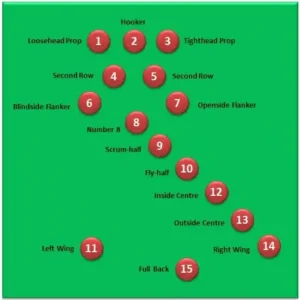
Understanding player positions is another important step in any rugby beginner guide.
Each position has unique responsibilities that contribute to the team’s success.
Forwards (Players 1–8)
Forwards are generally stronger and more physical.
Their responsibilities include:
- Winning scrums
- Competing in lineouts
- Securing possession
- Tackling
- Carrying the ball into contact
- Supporting teammates at rucks and mauls
Forward Positions
- Loosehead Prop
- Hooker
- Tighthead Prop
- Lock (2)
- Blindside Flanker
- Openside Flanker
- Number Eight
These players perform much of rugby’s physical work.
Backs (Players 9–15)
Backs are typically faster and more agile.
They create attacking opportunities through speed, passing, kicking, and intelligent positioning.
Back Positions
- Scrum-half
- Fly-half
- Inside Centre
- Outside Centre
- Left Wing
- Right Wing
- Fullback
Many spectacular tries are finished by backs, but they also play a vital defensive role.
Difference Between Rugby League and Rugby Union
One of the most common beginner questions is the difference between Rugby League and Rugby Union.
Although they share many similarities, the two sports have several important differences.
| Feature | Rugby Union | Rugby League |
|---|---|---|
| Players per team | 15 | 13 |
| Scrums | Frequently contested | Less competitive |
| Lineouts | Yes | No |
| Rucks | Highly contested | Simpler play-the-ball restart |
| Possession | Unlimited phases | Six tackles before turnover |
| Style of play | Tactical and structured | Faster and more continuous |
| International popularity | Played widely worldwide | Strongest in Australia, England, and New Zealand |
Which version is better for beginners?
Both versions are enjoyable, but Rugby Union is generally recommended because:
- It is played in more countries.
- More clubs offer beginner coaching.
- Most international tournaments use Rugby Union rules.
- Learning Union provides a solid foundation if you later explore Rugby League.
Essential Rugby Equipment for Beginners
Having the right equipment improves both safety and performance.
Rugby Ball
Choose a quality size appropriate for your age group.
Rugby Boots
Rugby boots provide traction on grass fields and help players maintain balance during scrums, tackles, and quick directional changes.
Mouthguard
A mouthguard is one of the most important safety items.
It helps protect:
- Teeth
- Jaw
- Lips
- Gums
Never play competitive rugby without one.
Shoulder Padding
Lightweight shoulder padding can help reduce the impact of tackles without restricting movement.
Headgear (Optional)
Soft rugby headgear may help reduce cuts and abrasions, although it is not designed to prevent concussions.
Comfortable Training Clothing
Wear breathable, flexible clothing that allows unrestricted movement during practice and matches.
Beginner Rugby Training Tips
Learning how to play rugby for beginners isn’t just about understanding the rules—it’s also about building the right habits. Rugby is a physically demanding sport, but with consistent practice and proper training, anyone can develop the skills and confidence needed to enjoy the game.
Here are some practical tips that will help you improve faster.
1. Focus on the Fundamentals First
Many beginners try to learn advanced tactics before mastering the basics. Instead, spend your first few weeks practicing:
- Backward passing
- Catching under pressure
- Safe tackling technique
- Ball handling
- Running support lines
- Basic kicking
Strong fundamentals create the foundation for long-term improvement.
2. Improve Your Fitness
Rugby requires a combination of:
- Strength
- Speed
- Endurance
- Agility
- Balance
A well-rounded training routine should include:
- Sprint intervals
- Strength training
- Core exercises
- Mobility work
- Cardiovascular conditioning
Improving your overall fitness allows you to perform better throughout the entire match.
3. Learn Proper Tackling Technique
Tackling is one of the most important basic rugby skills, but it must always be learned safely.
Remember to:
- Keep your head to the side.
- Wrap your arms around the opponent.
- Drive with your legs.
- Avoid high tackles.
- Release the tackled player once they’re on the ground.
Good technique protects both you and your opponent from unnecessary injuries.
4. Play as a Team
Rugby is built on teamwork.
Instead of trying to beat every defender yourself:
- Support teammates.
- Communicate constantly.
- Pass when someone is in a better position.
- Stay connected with your defensive line.
The best teams succeed because every player contributes.
5. Watch Professional Rugby
Watching experienced players is one of the fastest ways to learn.
Pay attention to:
- Player positioning
- Passing decisions
- Defensive organization
- Scrum formation
- Lineout execution
- Tactical kicking
Watching professional matches helps beginners understand how the game flows.
6. Join a Local Rugby Club
Nothing replaces hands-on coaching.
Joining a rugby club allows you to:
- Learn correct techniques.
- Practice with experienced players.
- Build confidence.
- Improve faster through regular matches.
Most clubs welcome beginners and offer structured coaching sessions.
Common Mistakes Beginners Should Avoid
Every new player makes mistakes. The key is learning from them quickly.
Throwing Forward Passes
The most common beginner error is forgetting that rugby passes must travel backward or sideways.
Always check your body position before passing.
Holding the Ball Too Long
Trying to do everything alone often leads to turnovers.
Pass early and trust your teammates.
Poor Positioning
Standing in the wrong place makes it difficult to attack or defend effectively.
Stay connected with your teammates and keep moving to support play.
Tackling Too High
High tackles are dangerous and illegal.
Always aim below the shoulders and use proper tackling technique.
Ignoring Fitness
Many beginners underestimate how physically demanding rugby can be.
Improving your endurance and strength will make every aspect of the game easier.
Rugby Safety Tips for Beginners
Although rugby is a contact sport, following proper safety practices significantly reduces the risk of injury.
Always remember to:
- Warm up before training.
- Cool down after matches.
- Wear a properly fitted mouthguard.
- Use the correct tackling technique.
- Stay hydrated.
- Listen to your coach.
- Report injuries immediately.
- Never play through a suspected concussion.
Safety should always come before competition.
Frequently Asked Questions
Is rugby difficult to learn?
Not at all. While rugby has several unique rules, beginners usually understand the basics after a few practice sessions. Consistent training and coaching make learning much easier.
What is the most important rule in rugby?
The most important rule is that players cannot pass the ball forward. All passes must travel backward or sideways, although kicking forward is allowed during open play.
Can adults start playing rugby?
Yes. Many amateur clubs welcome adult beginners with no previous experience. Training programs are often designed to teach the fundamentals gradually.
What fitness level do I need to play rugby?
You don’t need to be an elite athlete to start. Basic cardiovascular fitness, strength, and mobility are enough for beginners, and your conditioning will improve with regular practice.
Is rugby safe for beginners?
Yes, when played under qualified coaching and according to the official rugby rules and regulations. Learning proper tackling technique and wearing appropriate protective equipment greatly improves safety.
What is the difference between Rugby League and Rugby Union?
The biggest differences involve the number of players, possession rules, and game structure. Rugby Union has 15 players per team and contested rucks and lineouts, while Rugby League has 13 players and a six-tackle system.
Final Thoughts
Learning how to play rugby for beginners may seem challenging at first, but every experienced player started with the same questions. By understanding the basic rules, practicing essential rugby skills, improving your fitness, and working as part of a team, you’ll quickly gain confidence both on and off the field.
Whether your goal is to join a local club, compete at a higher level, or simply enjoy watching the sport with a better understanding of the action, rugby offers an exciting combination of athleticism, strategy, and teamwork. Focus on steady improvement, stay disciplined during training, and enjoy the learning process.
As your knowledge grows, you’ll appreciate why rugby is respected worldwide—not only for its fast-paced gameplay but also for the values of respect, discipline, and sportsmanship that define the sport.