Introduction
Every rugby team has 15 players, but not every player performs the same job. Each position on the field comes with specific responsibilities, unique skills, and an important role in helping the team succeed. For beginners, understanding these positions is one of the biggest steps toward learning the game and enjoying it with confidence.
Whether you’re planning to play rugby at school, join a local club, or simply want to understand matches better, learning rugby positions explained for beginners makes the game much easier to follow. Once you know who does what, you’ll recognize why certain players are involved in scrums, lineouts, attacking plays, or defensive situations.
If you’re completely new to the sport, it’s helpful to start with this comprehensive guide on how to play rugby for beginners before learning individual player roles. Understanding the basic rules, gameplay, and scoring system will make each position much easier to understand.
In this guide, you’ll learn every rugby position, the responsibilities of forwards and backs, the skills needed for each role, and practical tips for choosing the best position based on your strengths.
What Are Rugby Positions?

Rugby positions refer to the specific roles assigned to each player on the field. Every position has different responsibilities during attack, defense, scrums, lineouts, and open play.
Unlike some sports where players perform similar tasks, rugby relies on specialization. Some players focus on strength and physical contests, while others rely on speed, agility, passing accuracy, and tactical decision-making.
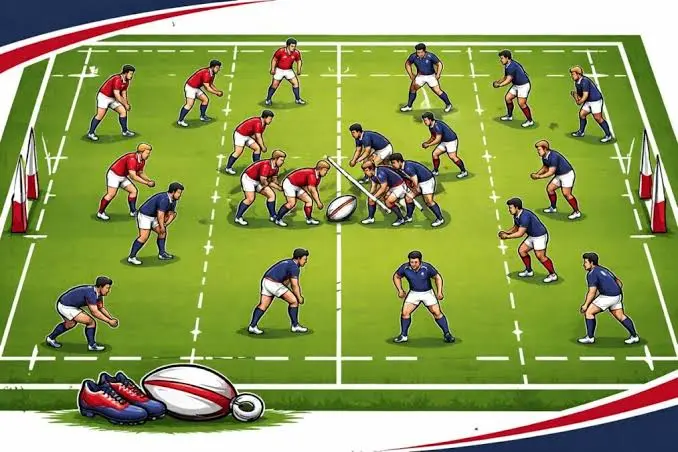
A standard rugby union team consists of 15 players, divided into two main groups:
- 8 Forwards
- 7 Backs
These two groups work together throughout the match. While forwards usually compete for possession and provide physical power, backs focus on creating attacking opportunities and scoring tries.
Understanding this structure helps beginners appreciate how teamwork plays a bigger role than individual performance.
For official rules, player responsibilities, and the latest law updates, beginners can also refer to the World Rugby Laws of the Game.
Why Understanding Rugby Positions Is Important
Learning player positions improves both your knowledge of rugby and your ability to contribute on the field.
Knowing each position helps you:
- Understand how the game flows.
- Recognize the responsibilities of every player.
- Improve communication with teammates.
- Identify which position best matches your physical abilities.
- Develop position-specific skills during training.
Many beginners try different positions before finding the one that suits them best. Coaches often evaluate a player’s speed, strength, height, endurance, and decision-making before assigning a permanent role.
The Two Main Groups of Rugby Players
Every rugby union team is divided into two primary units that perform different tasks during the match.
Forwards
The forwards are responsible for winning possession and providing physical strength. They are heavily involved in scrums, lineouts, rucks, mauls, and close-contact situations.
Their responsibilities include:
- Winning possession during set pieces.
- Supporting teammates at breakdowns.
- Carrying the ball into contact.
- Defending against powerful attacks.
- Creating space for the backs.
Forwards usually rely on:
- Strength
- Power
- Endurance
- Aggressive tackling
- Team coordination
Although forwards are generally bigger and stronger players, modern rugby also requires them to handle the ball effectively and contribute during open play.
Backs
The backs are primarily responsible for creating attacking opportunities and finishing scoring movements.
Their duties include:
- Passing quickly across the field.
- Exploiting defensive gaps.
- Kicking strategically.
- Supporting counterattacks.
- Scoring tries.
Successful backs often possess:
- Excellent speed
- Agility
- Ball-handling skills
- Vision
- Tactical awareness
While they are known for exciting attacking plays, backs also play an important role in defense by making tackles and organizing the defensive line.
Rugby Forward Positions Explained
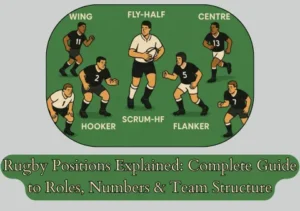
Each of the eight forwards has a specialized role during different phases of the game.
Loosehead Prop (Number 1)
The loosehead prop is positioned on the left side of the front row during scrums.
Primary responsibilities include:
- Providing stability during scrums.
- Supporting the hooker.
- Carrying the ball in short-distance attacks.
- Making strong tackles around the breakdown.
A good prop combines physical strength with excellent balance and technique.
Hooker (Number 2)
The hooker stands between the two props and performs one of the most technically demanding jobs on the field.
Key responsibilities include:
- Winning possession during scrums by hooking the ball.
- Throwing accurately during lineouts.
- Supporting rucks and mauls.
- Making tackles in close-contact situations.
Accuracy, quick reactions, and communication are essential qualities for this position.
Tighthead Prop (Number 3)
The tighthead prop anchors the opposite side of the front row and faces enormous pressure during scrums.
Responsibilities include:
- Maintaining scrum stability.
- Supporting powerful forward drives.
- Protecting possession.
- Carrying the ball into heavy defensive areas.
This role demands exceptional upper-body strength, endurance, and technical skill.
Locks (Numbers 4 and 5)
Often called the “second row,” the locks are usually among the tallest players on the team.
Their main responsibilities are:
- Jumping during lineouts.
- Providing power in scrums.
- Winning aerial possession.
- Supporting ball carriers.
- Securing possession at rucks.
Height and strength are major advantages for players in these positions, but mobility has also become increasingly important in modern rugby.
Flankers (Numbers 6 and 7)
Flankers are among the hardest-working players on the field because they constantly move between attack and defense.
Their responsibilities include:
- Winning turnovers.
- Making tackles across the field.
- Supporting attacking phases.
- Competing at the breakdown.
- Pressuring the opposition’s ball carriers.
Because of their versatility, flankers need an excellent combination of fitness, speed, strength, and decision-making ability.
Number Eight (Number 8)
The Number Eight controls the ball at the back of the scrum and often links the forwards with the backs.
This player is responsible for:
- Controlling possession at the base of the scrum.
- Carrying the ball in powerful attacking runs.
- Supporting both attack and defense.
- Creating momentum for the team.
A successful Number Eight combines physical strength with impressive ball-handling ability and tactical awareness.
Rugby Back Positions Explained for Beginners
After understanding the forwards, it’s time to learn about the backs. These players are responsible for creating attacking opportunities, controlling the game’s tempo, and finishing scoring moves. When learning rugby positions explained for beginners, understanding the backline is just as important as learning the forward pack because both groups work together throughout the match.
The seven backs usually rely on speed, agility, decision-making, accurate passing, and tactical kicking to move the ball into dangerous attacking areas.
Scrum-Half (Number 9)
The scrum-half is often considered the link between the forwards and the backs. This player controls the flow of the game by quickly distributing the ball from scrums, rucks, and mauls.
Main responsibilities include:
- Passing the ball accurately to teammates.
- Organizing attacking plays.
- Making quick tactical decisions.
- Supporting both attack and defense.
- Communicating with players across the field.
A successful scrum-half needs excellent vision, fast reactions, and strong leadership skills.
Fly-Half (Number 10)
The fly-half is one of the most influential players on the team and is often called the team’s playmaker.
This position requires outstanding game awareness because the fly-half decides whether to pass, kick, or run with the ball.
Key responsibilities include:
- Directing attacking movements.
- Creating scoring opportunities.
- Tactical kicking.
- Reading the opposition’s defense.
- Making quick decisions under pressure.
For beginners learning rugby positions explained for beginners, the fly-half demonstrates how strategy and decision-making are just as important as physical strength.
Inside Centre (Number 12)
The inside centre combines strength with ball-handling ability.
Players in this position often:
- Break defensive lines.
- Support attacking moves.
- Create space for teammates.
- Make strong defensive tackles.
The inside centre acts as an important connection between the fly-half and the outside backs.
Outside Centre (Number 13)
The outside centre focuses on speed, timing, and creating opportunities.
Responsibilities include:
- Exploiting gaps in the defense.
- Supporting fast attacks.
- Passing accurately under pressure.
- Defending against opposing centres.
This position rewards players with excellent running lines and strong decision-making.
Wingers (Numbers 11 and 14)
Wingers are usually the fastest players on the rugby field.
Their primary objective is to finish attacking moves and score tries.
Key responsibilities include:
- Finishing attacks near the touchline.
- Supporting counterattacks.
- Chasing tactical kicks.
- Defending wide areas.
- Using speed to beat defenders.
Players who enjoy running with the ball and attacking open space often enjoy playing as wingers.
Fullback (Number 15)
The fullback is positioned behind the defensive line and acts as the team’s last line of defense.
Responsibilities include:
- Catching high kicks.
- Launching counterattacks.
- Organizing the defensive backline.
- Making important one-on-one tackles.
- Returning possession after opposition kicks.
A quality fullback combines speed, confidence under pressure, and excellent positioning.
How Beginners Can Choose the Right Rugby Position
Choosing the right position depends on your physical attributes, athletic abilities, and personal playing style.
Understanding rugby positions explained for beginners helps new players identify where they can contribute most effectively rather than simply choosing a position based on preference.
If You Are Strong and Physical
You may be better suited for forward positions such as:
- Prop
- Hooker
- Lock
- Number Eight
These roles require strength, endurance, and physical commitment.
If You Are Fast and Agile
Back positions may be a better fit.
These include:
- Scrum-half
- Fly-half
- Centre
- Wing
- Fullback
These positions reward speed, agility, passing accuracy, and tactical awareness.
Talk to Your Coach
Most beginners experiment with different positions during training.
An experienced coach can evaluate your:
- Height
- Strength
- Speed
- Ball-handling ability
- Decision-making
- Fitness level
Finding the right role early helps players develop position-specific skills more quickly.
If you’re buying your first rugby equipment, choosing the best rugby ball for beginners can also make practice sessions more enjoyable and help improve passing, catching, and overall ball control.
Essential Skills Every Rugby Player Should Develop
Although every position has unique responsibilities, some skills benefit every player regardless of where they play.
These include:
- Accurate passing
- Safe tackling technique
- Ball handling
- Communication
- Fitness and endurance
- Game awareness
- Decision-making under pressure
Developing these fundamentals will help beginners perform better in every rugby position.
Common Mistakes Beginners Make When Learning Rugby Positions
Many new players misunderstand how rugby positions explained for beginners actually work. Learning the responsibilities of each role takes time, and avoiding common mistakes will help players improve much faster.
Choosing a Position Based Only on Size
While body type is important, modern rugby also values speed, skill, and decision-making.
Large players still need good handling skills, while smaller players must develop strength and defensive technique.
Ignoring Defensive Responsibilities
Every player attacks and defends.
Even wingers and fullbacks must make tackles, while forwards often contribute during attacking phases.
Understanding complete player responsibilities creates a more balanced athlete.
Trying to Play Every Position
Beginners should learn the basics of every role but focus on mastering one primary position before experimenting with others.
Specialization improves confidence and overall performance.
Frequently Asked Questions
How many positions are there in rugby?
A rugby union team has 15 positions, including 8 forwards and 7 backs, each with specific responsibilities during attack and defense.
Which rugby position is best for beginners?
There is no single best position. The ideal choice depends on your size, speed, fitness level, and playing style. Learning rugby positions explained for beginners helps players identify the role that best matches their strengths.
Which rugby position requires the most speed?
Wingers and fullbacks are usually the fastest players because they often finish attacking moves and defend large areas of the field.
Can beginners change positions later?
Yes. Many players start in one position and move to another as they develop new skills and gain experience.
Final Thoughts
If you want to continue learning through structured coaching resources and beginner training materials, visit England Rugby Coaching Resources for additional guidance.
Understanding rugby positions explained for beginners is one of the best ways to build confidence and improve your knowledge of the game. Every position has a unique purpose, and successful teams rely on every player performing their role effectively.
Whether you prefer the physical challenge of the forwards or the speed and creativity of the backs, learning the responsibilities of each position will make rugby more enjoyable to play and easier to understand. As your skills develop, you’ll discover which position best matches your strengths and allows you to contribute most to your team’s success.